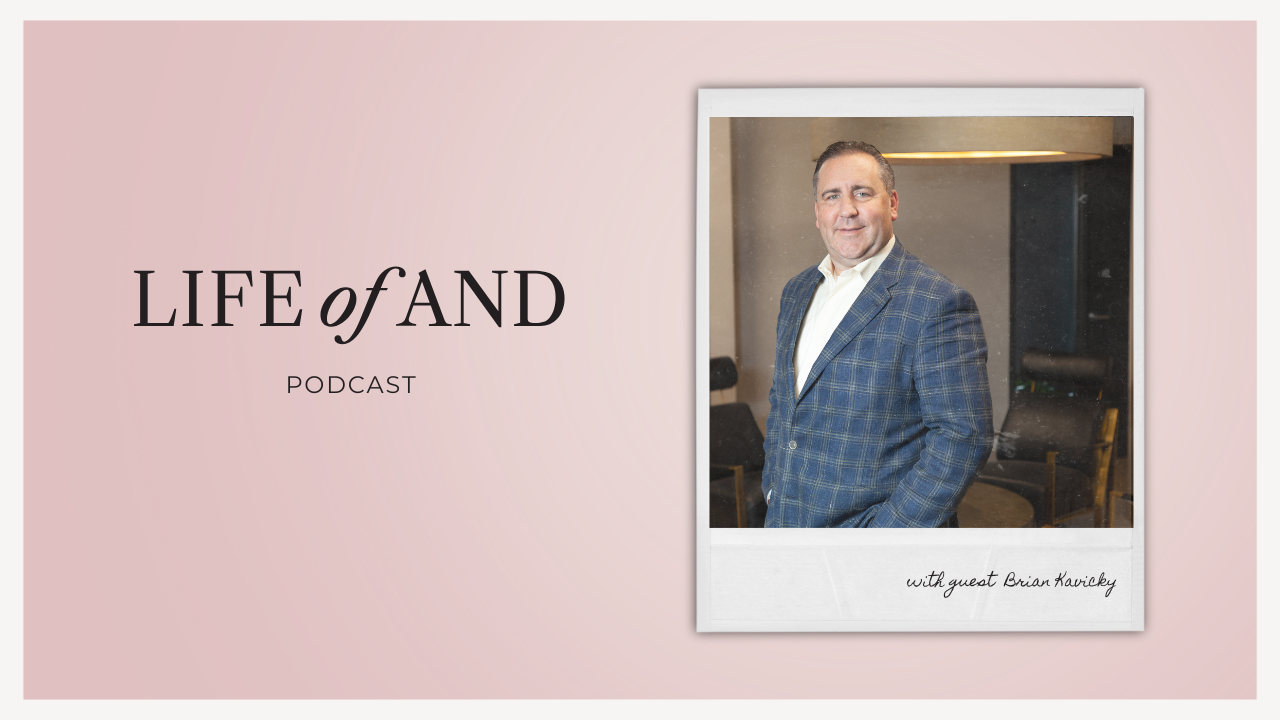
301: Overwhelm + Decision Fatigue: The Self-Trust Reset
APPLE PODCASTS | YOUTUBE | SPOTIFY
Decision Fatigue Is Real — and It’s Quietly Stealing Your Self-Trust
There’s a sentence I hear from women in leadership all the time this time of year:
“I know what I should do… I’m just exhausted.”
Not confused. Not unqualified. Not lacking wisdom. Just… completely worn out from deciding.
And here’s what I’ve learned the hard way: when decision fatigue sets in, it doesn’t just slow us down. It quietly erodes our confidence. We start second-guessing decisions we would’ve made easily in another season. We lose trust in ourselves—not because we’re doing anything wrong, but because we’re carrying so, so much.
In this episode of Life of And, I sat down with Brian Kavicky (who’s been in my corner for 14 years… which means he’s seen me in every version of “high-functioning chaos”). And we unpacked what decision fatigue really does to high-performing women—especially working moms—and how it connects directly to the thing nobody wants to admit they’re struggling with:
self-trust.
Self-Trust Isn’t About the Decision… It’s About What Happens After
I asked Brian to define self-trust because I wanted us anchored in something concrete.
His definition hit me right between the eyes:
Self-trust is making a decision—and not re-litigating it afterward.
So many of us think we “don’t trust ourselves” because we’re afraid of making the wrong call. But what we’re really afraid of is the after part: the feedback, the consequences, the discomfort, the pushback, the uncertainty.
In other words: we’re not avoiding the decision.
We’re avoiding what it will feel like once the decision is out in the world.
And yes… that is wildly relatable.
Two Moments When My Self-Trust Felt Paper-Thin
When I think about seasons where my self-trust felt the most vulnerable, two moments stand out.
1) The moment I realized my marriage wasn’t what I was pretending it was
There was a point in my marriage with JR where I had to stop pretending everything was fine. And that realization didn’t just make me sad—it made me question everything.
It’s like the ground shifts underneath you.
You start thinking, “If I can be wrong about this… what else am I wrong about?”
And the crazy thing is: in that same moment, I needed to be the most discerning version of myself because we needed help. But I was emotionally raw and still showing up to work and being “fine” enough for everyone else.
Self-trust felt dangerous. Like if I made the wrong move, I could break everything.
2) The Christmas lights night (aka: why was I on a ladder at midnight?)
This one still gets me.
Aubrey and Ainsley were little. Ivy was a baby—I was nursing, exhausted, and just back to work after maternity leave. JR had torn his bicep and had surgery right before Christmas. He couldn’t shower on his own. He was in pain. The whole house felt like survival.
And then the girls said something that just wrecked me:
“Our house doesn’t look very Christmasy.”
We didn’t have lights up.
So what did I do? Like a perfectly rational adult?
I went outside… in the middle of the night… with a stepladder… and a bunch of mismatched light strands… alone… in Indiana… on wet grass… and put the lights up.
Looking back, I’m like:
Why didn’t I just go to Lowe’s the next day and buy a blow-up snowman and call it a win?
But I didn’t have the capacity for a reasonable decision. And when you’re deep in overwhelm, your brain can’t seem to find “simple.”
It can only find more.
More effort. More pressure. More proof that you’re holding it all together.
The Tyranny of the Urgent
Brian named what was happening in that season for me and I swear it’s the most accurate phrase I’ve ever heard:
The tyranny of the urgent.
When urgency becomes the ruler, it starts telling you:
-
“You don’t have time to think.”
-
“Everything matters equally.”
-
“Do it now or it will fall apart.”
And suddenly, important and urgent blur together until you can’t tell the difference.
You actually know your priorities. You just can’t access them when you’re overwhelmed.
Which is why advice like “just slow down” feels like someone blowing in your face while you’re trying not to fly off the rollercoaster.
The First Step Out of Overwhelm Is Not a Plan. It’s Recognition.
Here’s the breakthrough:
If you can learn the signs that you’re tipping into irrational-mode, you can pull a lever before it becomes crisis.
Brian asked me, “If I had asked you at the time if you were overwhelmed, would you have known?”
Yes. Immediately.
So that’s the indicator.
When you feel overwhelmed, that’s your signal to do one thing first: add objectivity.
Because in overwhelm, you’re not thinking clearly—you’re reacting. You’re not building a series—you’re trapped in everything-at-once.
And the easiest way to regain clarity is to borrow someone else’s rational brain.
Call your mom. Call a mentor. Call a friend who won’t just say “same.” Call someone who can help you sort urgent vs. important and give you a first step.
Overwhelm starts to loosen its grip the moment you have one next action. Then your brain can find the next one. And the next one.
The Uncomfortable Truth: Overwhelm Can Become a Racket
We went somewhere spicy in this conversation—because it’s true.
Sometimes overwhelm becomes… a racket.
A racket is a bad behavior that gives you a payoff.
And some of the payoffs I’ve seen (in myself and other women) look like:
-
“Look how much I’m doing.”
-
“I’m the glue holding this all together.”
-
“I must be important if everything depends on me.”
-
“If I’m overwhelmed, I don’t have to deal with the real problem.”
This is where busyness becomes dangerous. Because busyness can be a brilliant avoidance strategy—especially when the real decision is hard, emotional, or high consequence.
Brian called out something I wish I’d learned earlier:
We’ll make a hundred tiny decisions (pantry, dishwasher, gas tank, errands) to avoid the one big decision that actually needs to be made.
And overtime… we stop trusting ourselves, because we know we’re not being honest.
Pushback Doesn’t Mean You’re Wrong
This part is for every woman who makes a hard call at work, announces it… and then feels herself crumble when the team reacts.
Brian said something I see all the time:
Women make a strong decision, they’re clear, they ship it…
…and then they start getting feedback.
Pushback. Resistance. Alternative opinions. Complaints.
And instead of thinking, “This is normal resistance to change,” we think:
“Maybe I got it wrong.”
The more we adjust or backpedal, the more we teach our people:
“If I push back, I can change the outcome.”
And then we wonder why we trust ourselves less and less over time.
Here’s the truth:
You control the decision. You don’t control the aftermath.
You don’t control how they receive it, interpret it, or respond.
Letting go of that false sense of control is actually what restores self-trust.
The Weird Encouraging Part: Only High Performers Deal With This
This might be the most hopeful thing Brian said:
If you’re dealing with decision fatigue and self-trust erosion, it’s often because you’re actually really good at carrying a high load.
You don’t get overwhelmed by responsibilities if you haven’t been capable of holding a lot.
You don’t start questioning decisions if you haven’t been making decisions that create change.
So if this is you, it’s not proof you’re failing.
It may be proof you’re right on the edge of a breakthrough… and you just need a lever.
Where Do You Start?
Start here:
-
Notice the early signs.
When you feel overwhelmed, irritated, reactive, or like every decision feels heavy—that’s the moment. -
Phone a friend (on purpose).
Have one person you can call and say:
“Okay, here’s what Crazy Pants is about to do. Talk me off the ledge.” -
Don’t change the decision just because you’re getting feedback.
Get an objective viewpoint to affirm it or tweak how you roll it out—but don’t abandon it out of fear. -
Interrupt crisis mode before it becomes your lifestyle.
Crisis can be a moment. It does not have to become a personality.
Self-trust isn’t about having all the answers.
And it’s not about never feeling overwhelmed.
It’s about recognizing the moment you’re slipping into cape-on-superhero mode… and calling a timeout before it costs you.
[00:00:00] Brian Kavicky: When you're getting overwhelmed, be ready for those moments that you are going to have to reach out to somebody in your network, a mentor, a peer, somebody to get an objective viewpoint to affirm your position or maybe tweak it a little bit. To improve the outcome, but to not change it because you're probably making a good decision if you're questioning that decision, and as long as you start to recognize it as it's happening and have a plan and a lever to pull when that happens. [00:00:30] Brian Kavicky: It's not gonna go away. You're just getting in front of it before it gets to severe crisis mode. [00:00:36] Tiffany Sauder: I'm Tiffany Sauder, entrepreneur, wife, mom to four girls and a woman figuring it out just like you. If you're tired of living a life of have to and finally ready to build a life of want to, then you're in the right place. [00:00:49] Tiffany Sauder: Come on, let's go Build your Life of And. [00:00:59] Tiffany Sauder: This time of year, one of the most common things I hear from women in leadership is, I know what I should do. I'm just exhausted. I'm not confused. Well, maybe a little, a little confused. I'm just so, so tired of deciding things. And what I've learned is that when decision fatigue sets in, it doesn't just slow us down, it quietly erodes our confidence. [00:01:18] Tiffany Sauder: We start questioning decisions we've, we would've made easily in another season. Today I wanna talk about how decision fatigue. Impacts our performance and why so many capable women start to lose trust in themselves. Not because they're doing anything wrong, but because they're just carrying so, so much. [00:01:36] Tiffany Sauder: Brian, I feel like this is something you see all the time in high performing women, especially women who are just juggling a ton. Careers, family, their own self-development teams, communities that are relying on them. And so I'd love to just unpack this whole concept with you. [00:01:49] Brian Kavicky: Well, that sounds fun. [00:01:51] Tiffany Sauder: So, uh, welcome back to another episode of Life of And. This is what we're doing today. Uh, and Brian's gonna be joining me in this conversation. You, we've been working together for 14 years and you walked through me in a lot of these seasons. And so before we dig too much deeper, I wanna define self-trust just to anchor us in this conversation. [00:02:11] Tiffany Sauder: And then I'm gonna share a couple of. Stories that for me, sort of epitomize the very valley of some moments for me in my journey to today. And then we're gonna just kind of like start unpacking this. So that's what we're gonna do. Before we dig too much deeper into this, can we just pause and can we define self-trust? [00:02:31] Tiffany Sauder: Can you help us with that? [00:02:33] Brian Kavicky: Yeah. So I, I would define it as self-trust, is that when I, when I make a decision or I take an action or I decide on a direction. That once I've made that decision, I don't question it again. So it's, I, I think a lot of times people will say things like, well, I don't trust myself to make that decision, or I don't trust that I know, or have enough experience to do that. [00:02:59] Brian Kavicky: But the reality is, is, is they're gauging their ability to buy into that decision, post-decision, not pre-decision. They're avoiding the aftermath of the decision, not the decision. So. [00:03:11] Tiffany Sauder: Can I paraphrase that? So what I think I, what I hear you saying is self-trust is about saying irrespective of what happens the after part. [00:03:20] Tiffany Sauder: I'm trusting that in the moment with the information that I have, the context that I have right now, I'm confident in this decision and we're shipping it. That's what you mean by that? [00:03:27] Brian Kavicky: Yes. [00:03:27] Tiffany Sauder: Okay. So let me add these two stories in and maybe even see how we put, I'm thinking of like an m and m where you've got like the peanut, the the chocolate and the candy wrapper. [00:03:37] Tiffany Sauder: 'cause I think. To me what we're talking about self is like the peanut of it. It's like the core, but it gets, I think, even messier than that simplicity when we're sitting in the context of a high achieving, busy working mom in particular's life. So two stories as I was thinking about where my own self-trust felt so vulnerable. [00:03:58] Tiffany Sauder: One was when I, I realized JR and I's marriage was not what I had. I would say believed it to be, but I think that's probably not even a hundred percent honest. What I had suddenly realized I had to stop pretending it was, but that pretending had become so much part of the way we interacted and sort of the way I wanted to believe it to be that it was the sort of preferred pattern, you know? [00:04:23] Tiffany Sauder: And we have this moment where I realized, holy crap, this is not what I thought it was. And it eroded my confidence. It made me feel incredibly vulnerable. And it made me feel like, what else am I, I I to? Then I couldn't have said, pretending is right but isn't, or pretending is okay but isn't, but like what else is not as it seems? [00:04:46] Tiffany Sauder: And it starts to just feel like the earth is moving underneath you. In that same moment, I also need to become one of the most discerning versions of myself because we need help, but I'm like a bleeding raw. Emotional, you know, thing. Still have to show up for work and pretend like everything's at least enough. [00:05:05] Tiffany Sauder: It's not my people's problem to fix. I've gotta figure out how to be discerning in the process of hiring somebody that can help us. But like, it's like I have to use my discernment brain, but also I need help so bad and I need to be able to be honest about that. And self-trust felt very scary and very vulnerable and very dangerous. [00:05:29] Tiffany Sauder: In a lot of ways. Second story is similar season. Aubrey and Ainsley were like six and eight. Ivy was a baby 'cause I was still nursing and it was a couple of weeks before Christmas, JR had been playing basketball. Something happened and he tore his bicep muscle, so he had to have this surgery where they like drill through your bone. [00:05:52] Tiffany Sauder: That's like the bad part. His bone pain is very, very. Ah, it's it like, it's terrible apparently. So he was, it was like around the holidays. He is in an enormous amount of pain, can't shower himself. Like, you know, this is what in the world is happening. I have this baby that I'm nursing and trying to drink enough water so that my body makes milk and doing my job, and I'm just getting back to work after maternity leave. [00:06:17] Tiffany Sauder: And then I have a six and an 8-year-old who rightly have some magical expectations of Christmas. They said to me when we were pulling in the house, our house doesn't look very Christmasy because we didn't have any lights up. It makes me emotional to think of it again. 'cause we didn't have any lights up and I was like, oh, I have to put lights up. [00:06:40] Tiffany Sauder: I have to put lights up, I have to put lights up. This is wild as this is making me cry. Um, it was like 10 years ago. And so that night I got out the stepladder. I, I found like every. This is wild. [00:06:54] Brian Kavicky: It's 'cause it's a memory. [00:06:55] Tiffany Sauder: Yeah. Every like extra strand of lights that I could find. And I went outside and I put these lights on and it was insane because it was the middle of the night. [00:07:06] Tiffany Sauder: I had a stepladder by myself in Indiana, you know, on the grass. Like what in the world? And I look back and say today actually when I was thinking about this story, this is not how I felt about it. It's interesting that talking about it made it more real. But I was like, why didn't I just go to Lowe's and buy a snowman, blow up and just like make it simple and spend 60 bucks and not make it so hard? [00:07:30] Tiffany Sauder: But in the, in the just like, I can't do one more thing and the things I'm doing are not enough was like how I felt. And apparently I don't feel that way, but wow. I was just like, okay, I'll do it. I did not have the ability to say, this is insane. Why would I get a stepladder out a bunch of mismatching light strands and not just explain to them, Hey, honey, like it's kind of a lot going on. [00:07:56] Tiffany Sauder: Dad just had surgery or go to Lowe's after school tomorrow and buy something silly, like a reindeer for the front yard. But I didn't have the capacity to make a, a reasonable decision, and so I continued to like make more true the unreasonableness of my life by making another unreasonable decision. I can see that now. [00:08:19] Tiffany Sauder: But when you're in it, it's the only thing your brain can come up with is another insane thing to do because you think this is the way that life just is. And so I make that true. So anyways, why am I crying? And we have to talk about this. [00:08:35] Brian Kavicky: So the why are you crying is that memories and emotions are glue in the brain to one another. [00:08:41] Brian Kavicky: So when you recall you, the reason that you remember it in visit detail is because it was an emotional time for you. You don't remember stuff. Like if I said, what did you do next Thursday? You don't remember because you didn't have emotional things. But if you go back to an emotional event, it always comes out. [00:08:56] Brian Kavicky: So that's why you do that. That's why, you know, like you remember trauma and all that stuff. The word is actually tyranny. 'cause that goes with the phrase tyranny of the urgent. And you know, if we talk about like a tyrant. A tyrant is somebody that takes over and says, I'm gonna run the country. You're gonna do whatever. [00:09:15] Brian Kavicky: I say, you can't think anymore. I'm gonna think for you. All of those things. And it's called the, the tyranny of the urgent. And that's what you became a victim to is I have to do this right now. And that is why it's completely irrational. Like why does one person able to go in and say, I'm the ruler of the country, and everybody goes, okay. [00:09:36] Brian Kavicky: It's the same thing. It's not even rational. There's more of them than one they could easily take over, but they just sort of cave into it. So that's what was happening to you. [00:09:45] Tiffany Sauder: So how does that connect to this idea of self-confidence? [00:09:53] Brian Kavicky: Because you get confused with what is important and what isn't. What is urgent. [00:10:00] Brian Kavicky: Become blurred and blended to one another where you can no longer tell the difference. It's this idea of everything is urgent and everything is an important, that it's this little lie that you say because you knew the order you were like. Dad has a, a surgery, he can't really do this right now. We've been busy with this. [00:10:21] Brian Kavicky: You knew the priorities of what was important. You were just unable to process them against urgent 'cause you made urgent as important. [00:10:29] Tiffany Sauder: So when we're in these seasons, because I, I hear this from women of like, I don't even have time to do something else. Like this is the only thing the, the. The rollercoaster has left the station, and I'm doing everything I can to essentially stay in the car because there's no seatbelt. [00:10:49] Tiffany Sauder: And you giving me advice is like blowing in my face. Like it's not that helpful. And so how, how do we recognize when we're in the season, how do we pause the rollercoaster to not mix a million analogies? How, how do we do that? [00:11:05] Brian Kavicky: It gets about stripping things away, and it sort of sucks because the, the answer is like right in front of you is you have to stop and take time to do, like to say to you in that moment, I want you to stop before you go out there and put the lights. [00:11:18] Brian Kavicky: I want you to stop and think about this. Your immediate reaction would be, I don't have time to think [00:11:23] Tiffany Sauder: totally, [00:11:24] Brian Kavicky: but you have time to go put 'em up on a ladder. And you haven't thought that through. It's, it's just this rational. So the, so the fix is to, is actually to start recognizing this is occurring to me. [00:11:37] Brian Kavicky: I am starting to do this. I am starting to do these crazy things, and that means that I'm being irrational, which means if I take the time to do a rational exercise of what is important and where do I need to spend the time, it will be worth it. But you have to learn the signs and and to recognize those signs. [00:11:59] Brian Kavicky: Otherwise you'll just keep cycling through it. [00:12:02] Tiffany Sauder: But I also hear women say, and I think this is like again, the self-trust thing is like, I don't know where to start. I don't know where my priorities are, but you listening to my story, were able to say, you know, your priorities, you just listed them JR. And then work and then the kids at Christmas. [00:12:16] Tiffany Sauder: Like, you're gonna get 'em all done, but make your decisions in that order and it's probably gonna be fine. I can't. See that in my story. I can't feel that in my story. Like it all has equal intensity of bright lights shining in my eyes as intensely as possible. And so how do we, how do we get ourselves? [00:12:34] Tiffany Sauder: 'cause I will, I will have women say to me, I, I don't know where to start. I don't know my, and I know you say like, figure out your priorities, but is it just literally stopping and calling your mom, telling a coach, telling a coworker, like, help me. Or just trusting yourself and saying like, write it down. [00:12:51] Tiffany Sauder: You're probably right. [00:12:52] Brian Kavicky: If I had asked you at the time, are you overwhelmed, would you have known that? [00:12:55] Tiffany Sauder: Yes. [00:12:56] Brian Kavicky: Okay, so there's your indicator, and the indicator says, if I'm overwhelmed, I need to do something. And that is what you said, call my mom, call somebody I trust, blah, blah, blah, and simply tell them I'm overwhelmed. [00:13:09] Brian Kavicky: I don't know what to do. Because that person isn't dealing with the irrational ness. That person isn't dealing with the emotions. They're coming from a place of objectivity. And they will switch whether they have skills or not. Their natural thing is that they're gonna switch to, well, let's talk you through it and blah, blah, blah, blah, blah. [00:13:29] Brian Kavicky: And you're sort of borrowing somebody else's rational objective viewpoint. Mm-hmm. When you don't have the ability to process it. So if I recognize, so the, the secret to getting out of overwhelm is to do one thing first. So if you're walking out to your car and you notice that your garage is filthy, and so you decide one day you're gonna clean your garage and you're looking at your garage and you're going, oh my gosh, it's such a mess. [00:13:54] Brian Kavicky: I don't know where to start. I don't know what to do next. The first thing you would do is let's just start taking stuff outta the garage. Or let's do this first. As long as you start with one action, your brain will start going, okay, now I have a next action. Now I have a next action. Now I, you have to get it into a series. [00:14:10] Brian Kavicky: 'cause overwhelm is, it's all coming at once. How do I get it into a series? So if I call somebody and say, what do I do? I'm overwhelmed. Okay, well how about you do this? Okay, how about you do this? Okay, because you knew to do that. Mm-hmm. I gotta do something. But if somebody gave you that, something you would've been in the same place and able to execute. [00:14:31] Tiffany Sauder: Is there also something that happens where in some ways I wanted to be that overwhelmed and busy? [00:14:38] Brian Kavicky: Yeah. It's a racket, [00:14:39] Tiffany Sauder: which makes me wanna vomit to say that out loud. Where does that come from? Because that's sick actually. But [00:14:48] Brian Kavicky: it's not that, [00:14:49] Tiffany Sauder: am I being so dramatic? Well, that's who I am. But I remember JR kind of looking at me and I'm like, I'm so, I, I said the words, I'm so overwhelmed, a disgusting number of times a day. [00:14:59] Tiffany Sauder: And I was like, that's the way I have to do it. To get all this done was my like stubborn energy. I think he was looking at me like, I don't know. Maybe that's not the only way, but you don't look open to other ideas, so I'll just let you be. [00:15:14] Brian Kavicky: It's probably not that. It's probably what, what thoughts I imagined came through his head was, what about me? [00:15:21] Brian Kavicky: Yeah, like, I have this unbearable pain, I have all this stuff in my head, I still have responsibilities. What about me? Mm-hmm. And so you actually get into this sort of competitive moment at that time because a, a racket is a bad behavior that you get a reward for. So you're, you're saying, I'm overwhelmed, or I'm overwhelmed and not getting stuff done, and you're getting rewarded somehow for that, you know, you're like. [00:15:45] Brian Kavicky: Well, the girls leave me alone. Or this, you're, you're getting some payoff and you're saying, I gotta keep doing this to get this payoff so to your It's sick. Yeah. It's a, it's twisted a little bit, but you, you needed a benefit in that moment. You needed to feel good because you weren't feeling good and the bad behavior helped you feel good. [00:16:05] Tiffany Sauder: Well, I think it can become intrinsic for women where. And I think this is probably part of the racket for JR. And I we're like, he's not naturally verbally affirming to me. He's gotten much better in our marriage, but just like, it's just not his, his way of appreciating me. And so I think part of me getting into this overperforming state was me being like, look, I'm amazing. [00:16:25] Tiffany Sauder: I can get so much stuff done. Like this is wild. Look at, look at this enormous list of stuff I'm doing. I think that was my version of the payoff was like, show me somebody else who's doing this much stuff. That was helping me to fill in this identity I wanted to have, which was like, I'm super high functioning and I can do it be great in a lot of different areas of my life to what cost. [00:16:48] Tiffany Sauder: I think I wasn't clear in the boundaries that that needed to live in, but I think that was my version of the TI don't know if you see that in other places that you, [00:16:56] Brian Kavicky: I've seen it in me when I, when I get into that mode, it's, see, look at all that I can do. [00:17:02] Tiffany Sauder: Mm-hmm. [00:17:02] Brian Kavicky: You know, it's this, this feeling of, you know, you're in this moment of I've, I'm overwhelmed. [00:17:07] Brian Kavicky: Come and you're switching it to, but look, I can handle it. I am amazing. I am important. I am the linchpin here. This is why, which, which then erodes your relationship even more. 'cause you're back competing. [00:17:22] Tiffany Sauder: I wanna take a quick moment to thank my partners at Share Your Genius. For the past four years, they have been an incredible part of my journey behind the microphone, Share Your Genius is a content and podcast production agency that helps leaders and brands bring their message to life. So whether you're trying to find your voice, develop a content strategy, or get your leader behind a microphone, they're gonna help you make it simple, strategic and impactful. [00:17:45] Tiffany Sauder: Do you think it also erodes your relationship with yourself? [00:17:49] Brian Kavicky: Yeah. 'cause you're lying to yourself. [00:17:50] Tiffany Sauder: Yeah. I think that's interesting though. And this very, it's like, it's like counterintuitive in the act of trying to give myself what it is I think I want, which is affirmation and a sense of I'm superwoman, I'm actually eroding my trust with myself 'cause I'm playing a game. [00:18:05] Tiffany Sauder: Inside of my own brain. That's wild. So what's, how does, what's a healthy version of that? [00:18:11] Brian Kavicky: So, a healthy version, going back to your topic of decision fatigue, is you're, you're starting to feel overwhelmed. You just don't want to decide. Even the little decisions bug you. You start to recognize that feeling and you go, I gotta step away. [00:18:24] Brian Kavicky: I have to take a deep breath. I have to step away. I have to focus on something different. I have to stop making decisions. I just have to move away. I don't have to be irritated with people. I don't have to have this whole thing leave me alone, but I have to step away and say I need to add objectivity. [00:18:40] Brian Kavicky: 'cause in those moments when it's not just crisis, you have a much greater ability to say. I just need some alone time. I just need to process some things. I just need to be with my thoughts for a little bit. [00:18:52] Tiffany Sauder: Mm-hmm. [00:18:52] Brian Kavicky: And work it all out to get yourself out of that stuff. [00:18:56] Tiffany Sauder: You said the word crisis and I sort of was thinking through this idea of we actually get to decide how long the crisis is. [00:19:02] Tiffany Sauder: So in JR’s example of his arm, it's like, okay, when he calls me from the gym and says. Which this is not like it ha the surgery doesn't have to be done in the next two minutes, but it's like, let's you call me from the gym. Something's wrong with your arm. You need me to come get you. That's like the crisis moment. [00:19:16] Tiffany Sauder: This is requiring urgency from me. But once we like understand what it is, we can choose to stay in crisis mode. Like clear the deck, everything has to change, blah, blah, blah, blah. Or we're gonna be like, okay, and now we just make a new plan. We've got new context, we make a new plan, and now we operate in that. [00:19:33] Tiffany Sauder: Is that true or am I, [00:19:35] Brian Kavicky: is that not true? Oh, it's true. Like if we said, let's, let's make a list of people who seem to always be in crisis mode. We can come up with names. [00:19:42] Tiffany Sauder: Yeah. [00:19:43] Brian Kavicky: But what does crisis mode do for somebody? 'cause it's a racket. [00:19:46] Tiffany Sauder: Mm-hmm. That's what I was, yeah. [00:19:48] Brian Kavicky: And, and the racket is I'm getting to avoid other things because these crises I'm dealing with, which are technically insignificant. [00:19:58] Brian Kavicky: Compared to what they're avoiding is allowing them to not process what the real problem is or deal with those real problems. So another thing with decision fatigue is just avoidance of a hard decision is you'll go, well, I'm gonna make these little decisions instead and avoid the big decision that's gonna have a higher consequence. [00:20:16] Brian Kavicky: Our brain is very good. Uh, it's actually called hyperbolic discounting, where we take a problem and we say, I don't want to deal with that problem. We bury it in our brain so that we don't have to process it emotionally and we walk around with it. Mm-hmm. So if you ask somebody, how are you doing? And they say, fine, that is, it's there, but I don't want to deal with it. [00:20:38] Tiffany Sauder: What's it called? Hyperbolic what? [00:20:39] Brian Kavicky: Hyperbolic discounting. [00:20:41] Tiffany Sauder: So that is. Right on the nose with another place that my brain went to when I was thinking about the season of my life, decision fatigue, lack of self-trust, is that I had an avoidance of the truth because it felt like one more thing to do. And so that's what this is, is this hyperbolic discounting where it's like addressing a major issue on my team where I need to go, you know, replace. [00:21:04] Tiffany Sauder: An executive that it's like it's working fine enough. It's the problem. I know, I know. It's probably creating more issues than I know. Like, 'cause you would say to me it's always bigger than you think it is. Or the issues in JR and I's marriage. It was like, it was just never a good day to address it until it became the day to address it. [00:21:22] Tiffany Sauder: Sometimes it can be issues with your health and like maintaining your own stamina. It can be problems with your kids where it's like, oh, it's not a good day to have this conversation with my, like, you just never find the moment. You fill up your time with like, yeah. Unloading the dishwasher and sweeping the floor and filling your car up with gas and reorganizing the pantry, and all of these things that are completely like irrelevant to the actual core of life, but can occupy a hundred percent of our energy. [00:21:52] Brian Kavicky: I'm gonna say it this way, but the, the idea of. Busyness is the devil's tool is a very real thing because busyness is avoidance and busyness is division, and busyness is separation because if I gotta empty the dishwasher, I don't have to deal with it if I gotta do this. It's always avoidance and distance. [00:22:12] Tiffany Sauder: So I've shared some examples in my life. You work with lots of high performing women. Are there other vignettes or stories or ex you know, things where you see this idea of lack of self-trust, decision fatigue? Come forward that maybe my audience could benefit from. [00:22:27] Brian Kavicky: So the, the two things of decision fatigue and self-trust go very close together. [00:22:33] Brian Kavicky: It's not just I'm tired of making decisions, it's, I don't trust myself to make the next decision or the decisions I'm making. I'm not sure we're the right ones so that we sort of have this reach back, look back kind of thing. You defined it very well when you said, you know, they're, they're looking at their decision and regardless of the aftermath. [00:22:54] Brian Kavicky: The ability to stick with that decision is based on what is the feedback that I'm getting. So one of the things that I see, especially with women, is they'll make a decision. They'll process that decision, they'll rationalize that decision, and they'll go, this is the right thing to do. And then they execute on that decision and make it known, and then they start to get feedback. [00:23:15] Brian Kavicky: It'll be like, well, I don't agree with you. I think there's a better way. What if we did it this way instead? What if we da, da, da? And now they're getting all these feedback loops coming from them. It's coming from people who the decision affects negatively to a degree, which is why they're pushing off and it causes, instead of going. [00:23:32] Brian Kavicky: Oh, they're resisting change right now. They go at as, Ooh, maybe I got it wrong. Maybe I didn't do that. And you know, one time, not a big deal. You get 10 times of that where actually your people have learned that if I push back, I might get a different outcome. You end up teaching people that, and then over time you trust yourself less and less and less over time because your feedback loop does not have the affirmation from somebody to go, no, it's the right decision. [00:24:01] Brian Kavicky: You're doing the right things. That is the right move. They're just pushing back 'cause they don't want it to affect them. And, and you get into that overwhelmed feeling again of maybe I can't even make decision. 'cause every decision I make, they don't trust, they don't respect, they push back. Maybe I shouldn't be in this position anymore. [00:24:18] Brian Kavicky: Maybe I shouldn't do this anymore. And you go in to give up, but you were making the right decisions. They were absolutely perfect decisions. [00:24:25] Tiffany Sauder: That's so true. As you were talking, it also makes me think that when that's the environment where you get where you start or stop decisions, you actually are not deciding the quality of your decisions on the actual outcomes. [00:24:38] Tiffany Sauder: It's on the sort of crowd's approval or not. And I think standing apart from the team in those moments is very hard for a woman. Like, you know, to say like, Hey, this is what we're doing. And the only times I think I've really done well at that is when I knew we have no option. [00:24:57] Brian Kavicky: Right. You no, your back was against the wall. [00:24:59] Tiffany Sauder: Totally. [00:24:59] Brian Kavicky: You had to do it. [00:25:00] Tiffany Sauder: And so I, I have to. Right. And I, and learning to make decisions before you get to that moment has been a real step of maturity for me of like, it doesn't have to get to the place where I used to say I played. I live life, like a game of bunker cars where I would go so fast until I hit the wall, and then I would go so fast until I hit the wall again. [00:25:17] Tiffany Sauder: It was like these crash moments that would get my attention to say, maybe you need to trust yourself. Maybe you need to look at your intuition nine months before, like maybe you need to trust yourself a little bit here and not have it have to get to the place where it's so acute to really stand in a new choice. [00:25:37] Brian Kavicky: But the root of this a lot comes back to this idea of a belief that I control more than I control. Like I control how they hear it, I control how they take it, I control how they respond. You don't control any of those things. You control the decision. You do not control the aftermath, how people receive it or what happens because of it is all outside of that. [00:25:58] Brian Kavicky: So people that have like, I want to be in control. I want to know, I control things. The mechanism to get better at control is to realize I don't have as much, I have control of myself. I have control of my decisions, but I don't have control of how people respond. Frees you up to go after this. It's not my problem. [00:26:18] Brian Kavicky: And that is a hard thing to let go of, is they're just gonna respond how they're gonna respond, but it's not gonna change my mind. And you have to be very convicted and this is the right decision ahead of that. So that you're not hit with that aftermath and letting it negatively affect you. And the best way to do that is to to talk with someone and go, how are they gonna take this? [00:26:40] Brian Kavicky: So you're prepared. And when those things happen, you go, oh, this is normal versus I did the wrong thing. [00:26:47] Tiffany Sauder: And you think to talk about as it relates to one of the issues that we were talking about before we pushed record a theme that would be helpful to, [00:26:54] Brian Kavicky: here's the last piece, and I hope this helps with people's thinking, is that. [00:26:59] Brian Kavicky: If you are dealing with this problem, it is because you are really good at making decisions and you're actually really good at managing your life and everything around it because you never get to this point of being overwhelmed with tasks and responsibilities if you weren't able to carry a high load. [00:27:21] Brian Kavicky: And you'd never get to this point of questioning your decisions if you weren't making good decisions that actually caused change. So the people that don't struggle with this ever and seem to just navigate life as if nothing's going on, aren't performing at their highest level in any way, shape or form, and aren't even close because they don't deal with this. [00:27:42] Brian Kavicky: So the good news is there's also an indicator of. I am doing a lot of things right, but I have to work on this as opposed to I can't do anything, right? I don't trust myself anymore. It's like, no, this is an indicator that you're right there on the precipice of just solving one little thing that can fix everything. [00:28:03] Brian Kavicky: It's not that I'm in the wrong position. I shouldn't have done this. Maybe I'm not good enough. All the little thoughts that go into your head, only high performers run into this problem. Which is a very weird thing to hear. [00:28:16] Tiffany Sauder: If someone's listening to this, they're like, okay, I get it. This is me. And they're like, where do I start? [00:28:21] Brian Kavicky: Start by first acknowledging that you know when it starts to happen, you know when you're getting overwhelmed, you know when you're getting reactions to your decisions to do that and be ready for those moments that you are going to have to reach out to somebody in your network, a mentor, a peer, somebody to go, I wanna tell you what I'm thinking and I wanna know. [00:28:44] Brian Kavicky: What you think to get an objective viewpoint to affirm your position or maybe tweak it a little bit to improve the outcome, but to not change it, because you're probably making a good decision if you're questioning that decision, and as long as you start to recognize it as it's happening and have a plan and a lever to pull when that happens to execute. [00:29:09] Brian Kavicky: You'll start to get right. 'cause it's not gonna go away. You're just getting in front of it before it gets to severe crisis mode. [00:29:16] Tiffany Sauder: Made me think of almost putting this question in your pocket where it's like, what decision could I make that would not make me feel overwhelmed? Like E, even my Christmas lights, it's like I could do it tomorrow because you just get in this reactive manner that just makes you manic. [00:29:31] Brian Kavicky: Yeah. But if you had called someone and said, yeah. [00:29:34] Tiffany Sauder: This is my idea. [00:29:35] Brian Kavicky: My kids. Yes. My kids have told me that it's not there and I just wanna go outside and put up lights. [00:29:41] Tiffany Sauder: Yes. [00:29:41] Brian Kavicky: Somebody would've said [00:29:42] Tiffany Sauder: yes. [00:29:43] Brian Kavicky: How about you say this to them and do this tomorrow? Yes. Like somebody would've given you that gift, but you didn't know to reach out. [00:29:50] Brian Kavicky: Yes. Because you're going, I gotta take care of this. Yes, I can handle this. I'm holding this all together. I'm the glue. You were in that racket mode. [00:29:57] Tiffany Sauder: Yes. [00:29:58] Brian Kavicky: You didn't pre-plan to make the call phone a friend. [00:30:01] Tiffany Sauder: Yes. I, I think that's a great segue into the close of like, you know, self-trust is not about having all the answers, and it's not about never feeling overwhelmed. [00:30:11] Tiffany Sauder: It's about having the confidence and the courage that you're gonna recognize that moment where it's like, man, I'm getting into this. I'm, I just strapped on my cape and I'm moving into superhero mode. Nobody's gonna win when I'm in this moment. And so step number one is to call a timeout, pick up the phone and call somebody and export. [00:30:32] Tiffany Sauder: This is about what Crazy Pants is about ready to do. Like can you talk a girl off the ledge? And you know, I think that what I love about this too, I think it can also be a racket where as professional women, we say, oh honey, I know me too. I'm so exhausted. And it's like we just perpetuate the racket with one another. [00:30:48] Tiffany Sauder: I think that's the biggest calling for me, for Life of And, is to say no, like. And you've taught me this, Brian, it's like, no, I don't need to accept any of those things in my life permanently. They may be conditions temporarily. They get my attention, that force new behaviors to be formed, new disciplines, new sort of like triggers of awareness. [00:31:08] Tiffany Sauder: But those are not conditions that we need to accept as a very nature of being a high achieving, performing person who says, I wanna be excellent every area of my life. And so I, I feel like what a cool. Summary to such an overwhelming feeling. I mean, it drew me to tears again eight years later, 10 years later. [00:31:30] Tiffany Sauder: And it's because you feel so incredibly alone. And the thing to do is to call somebody and reach out and say like, help me. So anyway, as always, thanks for joining me. Brian, if you are interested in having Brian or someone on his team help you with things like this, your mindset getting control over your. [00:31:47] Tiffany Sauder: Potential and growth in sales in your business, then reach out to Lushin. Thank you for joining me for another Episode of Life of And. This has been a really special one for some reason for me, and I hope that if this touched your life in any way that you share it with a friend, I really appreciate every single time you give us your gift of time. [00:32:05] Tiffany Sauder: And hope that you're having a wonderful New Year. Thanks for joining us. Brian. [00:32:10] Brian Kavicky: Thanks for listening to the Life of And. this is your weekly reminder to keep making bold choices, saying clear yeses and holding space for what matters [00:32:18] Tiffany Sauder: most. As always, if you like this episode, I'd love for you to drop a review and share it with your friend. [00:32:23] Tiffany Sauder: It's the fastest way that we can grow the show. Thanks for joining us. I'll see you next time.🎙️ View Transcript